Tuesday, July 7, 2015

July is Jumping

The rains that were absent without leave for most of June finally made an appearance in the final days of the month. And now we are (1) reaping the benefits and (2) paying the price. Ah, gardening...a double-edged trowel, to say the least.

First, a comparative series of photos, showing the progression over 6 months:

Box Garden in January, 2015

Box garden in the first week of May, 2015

Box garden in the first week of June, 2015

Box garden in the first week of July, 2015

As you can tell, the beans have taken over the tutuer in the Center Square. And with Mother Nature's moisture, the plants have begun to flower and produce again. Yay, rain! Of course, the wet conditions are perfect for supporting a growing Mexican bean beetle population. Boo, rain. And since I have been benched recently due to problems with my left foot (read more in the latest blog post. Click here to go there.), I haven't been able to keep on top of the pests, both weeds and insects. What a challenge!

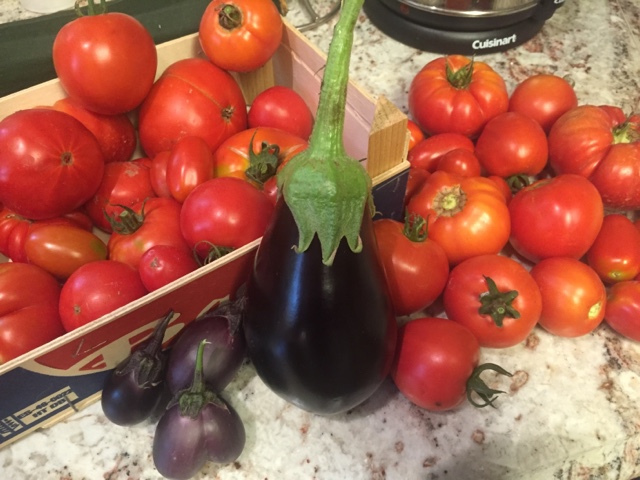
Still, Mr. T has been stepping in (no pun intended) to keep things going. And our tomatoes are really going, and going, and going...


As you can tell, we are getting tomatoes, peppers, eggplants, okra, cukes, and zukes, as well as beans. The yellow squash are beginning to give, and the Lima beans are starting to put on. And we are excited about two ripening crops, that we can almost taste:


Fingers crossed we get to eat our watermelons and corn this year...and not the raccoons, as in years past. We noticed that a coon had visited our suet feeders this weekend, so in spite of the dogs we still have the critters in residence.

And it looks like the tomatoes are beginning to show fungal problems (late blight?), so we will need to use the "suckers" we have potted up and well-rooted as pinch hitters. Need to get them in the ground this weekend, though, as we are coming on the last date for transplanting tomatoes in the Piedmont — July 15th.

The pumpkins I seeded just before my foot problems began have germinated and are beginning to vine, as are the Georgia Rattlesnake watermelons. Mr. T sprayed the vines with Sevin to try to keep the squash bugs and squash vine borers in check; he also sprayed the newly forming corn ears to combat corn worms. Although I prefer organic pest solutions, I had to concede that these take time and a dedicated gardener in residence...and that he is doing his best to fill in while I'm on the DL. "Needs must," as they say across the pond.

The report from the Berry Patch isn't quite as good. Although we had what appeared to be a record crop of blackberries, we are actually seeing very few. The blackbirds seem to know the Head Gardener is currently unavailable, and they are making the best of a bad situation. Or a good one...from their perspective, I suppose. 

The Rose Garden is holding its own these days, with the Japanese beetles scoring significant victories, especially among the tender new buds. But Mr. T sprayed the bushes with Sevin again on Saturday, so we should see some control through the end of their season. 

'Pat Austin' rose

And the daylilies are putting on a show, albeit with smaller and fewer blooms than in years past. Chalk another one up to lack of rain in their formative period. 

Harem House, blooming for the first time

New Jersey Spider

South Seas, a variety we brought from Missouri

Here Comes Santa Claus (gotta love that name!)


So, even though my participation has been curtailed for the time being, things are moving right along in the gardens. Yes, one might even say the joint is jumping. In July. 

One might....

Sunday, June 21, 2015

Say Hello to Summer

With the thermometer approaching 100 degrees on a daily basis and little (if any) measurable moisture in the rain gauge, we are seeing an alignment of the calendar and our concepts: Summer has definitely arrived in High Point. And nearly everything in our garden seems to be on the fast track to harvest...or wilting. Sigh. 

Kitchen Gardens —


In the Box Garden (shown in the photo above), I've pulled most of the cool season crops (broccoli, lettuce, etc.) and succession-planted most of the raised beds with several varieties of beans. And I have already harvested several pounds of green and burgundy beauties. 

In the Row Garden, I've harvested quite a few Juliets, as well as my first slicer (a Celebrity) for my first BLT of the season. 


I've also gotten a couple of sweet peppers, mini-eggplants, plus the first zucchini and cucumbers. 


I see several tiny watermelons peeping out of the vines. This little Sugar Baby baby may be our first test case on how to support melons on a wire-fence trellis (we're thinking of repurposed T-shirts threaded with wire coat hangers).


Because of some mislabeled seeds, we will have twice as many cukes (like this guy, below)...and no cantaloupes this year. I looked it up...June 10 was the last day to plant them in the Piedmont. 


And more beans...pole, as well as Limas. I sprayed with Sevin to help combat Mesican bean beetles and Japanese beetles...both of which devastated our bean crop last year. I do need to spray again, but it's just too hot. The label recommends temps BELOW 85 degrees (and the thermometer in the center of the Way Back is reporting 101.1 as I type this!)

And in the Block Garden, the corn is getting taller and the pumpkins have germinated. I have to water, water, water all of the above just to keep it alive.

Orchard —

While we have more fruit on the trees than last year when the late freeze zapped all of the flowers, we also have more pests to contend with. I've sprayed once with Orchard Spray, but need to spray a second time. Unfortunately we have usually passed the upper temperature limit of 85 degrees by 9:00 in the morning. Sigh.

Roses —

The first flush of blooms has come and gone on the David Austen English bushes. And now it is time for the hybrid teas to shine! I've fed and applied all-in-one product to the bushes, and I've sprayed with Sevin to protect against Japanese beetles...which showed up extremely early this year. We are now up to 74 roses, including our "bucket brigade:" we set up a temporary 'holding' area for several bareroot roses we got from Jackson & Perkins at their end-of-season sale...$9.95, plus a coupon for no shipping charges. While it's too hot to plant them in their permanent locations, we got 10 (5-gallon) buckets, drilled holes for drainage, and filled with a rose-friendly mixture of garden soil, compost, and leaf mold...and they stand in a shaded area like soldiers getting ready to do battle.


One fella (who was a container rose when purchased at Roses Unlimited on our recent trip to Lauren's, SC) is looking pretty good in his new home next to the fence, sporting a bud already. Don Juan is a red, climbing rose, which will need the support of the trellis and the fence.


Day lilies —

The show has begun! Even though our lack of rain is showing up in smaller and fewer flowers, you can't stop these beauties from producing. Here are a few stars:

Forever Redeemed 

Symmetry in Yellow

Buttered Popcorn 

Purple Pinwheel 

Alabama Jubilee 

Dad's Best White


Berry Patch —

The blueberry harvest has begun, and even though the lack of rain means fewer berries, it does seem the ones we are getting are sweeter. Amazingly, the blackberries are ripening at the same time as the blueberries. And while the grapes appear to be full of fruit, I noticed that the size of the clusters is smaller than last year.

That's how are garden is growing (in spite of the lack of rain). Hope yours is surviving.

Happy hoeing!


Tuesday, May 5, 2015

May Flowers

My previous post mentioned all the rain our gardens had been enjoying, apropos of April. Now, let's talk about the positive results we see in May.

This morning, I took a pre-breakfast coffee walk with a purpose. I had noticed on Sunday's walkabout, that in addition to the mountain of flowers, there were several nearly-ripe strawberries in the beautiful bed on the edge of the Berry Patch. 


I just knew I would find at least a handful in the first harvest of the season...but I was hoping for enough to make my bowl of Raisin Bran worth eating. I was justly rewarded for my two-day delay in picking.


While in the Berry Patch, I was thrilled to see all the lively blueberries on the bushes...won't be long now before the berries on my cereal will be blue instead of red! And the blackberry bushes are loaded with flowers, foretelling a heavy harvest in a couple of months. The grapes are adding leaves on all the vines, except one that was lost to winter damage. So far, so good.

Over in the Orchard, I noticed fruit on the pears, peaches, plum, apples, and crabapples. I need to spray sooner rather than later, since the trees have all finished flowering and this is one of the most vulnerable times to pest damage.

Checking on the Block Garden, where the (English) peas are busy vining up the fencing and flowering, I spotted some corn leaves poking out of the ground! Hooray! Ok, I admit I'd had my doubts. I planted those seeds of Silver Queen (some of which were from 2012!) on a rather cool day...and in extremely muddy conditions (I almost lost my garden clog to the sucking mud when I stepped in the wrong spot!). It was a case of having to plant that day...or wait another week or so until I returned from Georgia. So, maybe it will work out after all.

Then I moved on to the lettuce in Box #3 in the Raised Bed garden. Oh my goodness, what a delight for the eye! 


Of course, seeing all that lettuce reminds me of two stories:

1) After my parents retired and moved to Smithville, TN (buying my Aunt Christine's house on Jennings Lane), Daddy took on the weekly chore of going to the grocery store. He would start out with an early run to Webb's Drug Store on the Square for coffee...and the latest "news." Following any other trips (to the post office, to the hardware store, etc.), he'd eventually wind up at the Sav-a-Lot, where he thrived on getting the best bargains...and hopefully most of the items on Momma's shopping list.  One particular week, they had iceberg lettuce (the only kind he knew) 5 heads for $1.00. Granted, that's a great price, but remember it was just the two of them at home...and he was always more of a meat 'n potatoes kinda guy, calling salads "rabbit food." Anyway, he comes home with 5 heads of lettuce...to which Momma said "Sidney! What are we going to do with all that lettuce?" And he famously replied "well, we can freeze what we don't use...can't we?"

Ahem.

2) In 2011, just after we found out that Momma's lung cancer had returned, she became withdrawn and began staying home most of the time. So, I was preparing three meals a day, rather than counting on many meals eaten away from home. At about the same time, we were enjoying a bumper crop of salad greens. We had mounds of leaf lettuces on every sandwich; spinach leaves in omelettes; and a salad with almost every supper. When the Hospice volunteer came by for a visit, I overheard her ask Momma if she was eating well...meaning, did she still have an appetite for food? Momma exclaimed, "heavens yes! Patricia gives me a salad from her garden every time I open my mouth. I'm going to turn into a head of lettuce!"

Looks like 2015 might turn out to rival the salad days of 2011!

I did say this post was about May flowers, didn't I? The irises in the Rondel (the ones that are descendants of ones passed along to us by my Lunn cousin Betty Jean) are looking so pretty, with the red-bronze ones in full bloom and the yellow ones just beginning to open. 


And the (mostly purple) irises in the front yard have been putting on quite a show for us this year. We divided the ones around the lamppost last year, so I had little expectation of flowers this year. Wow! Did they ever surprise us!


The rhododendrons in the back yard are both in full flower, as the azaleas end their run for the year. 


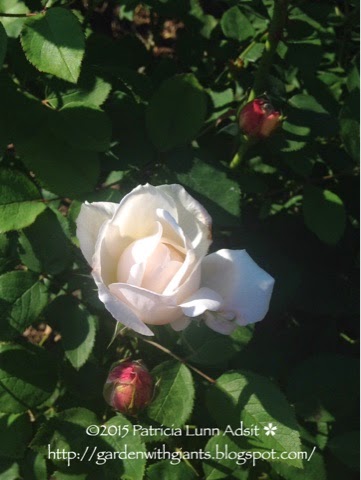
And the roses are loaded with buds, poised to pop open into a riot of colors over the next few weeks. As usual, the winner of "first bloom" in the Rose Garden is the David Austin rose "Susan Williams-Ellis." Although small by comparison with most of the so-called English roses, SWE has proven both hardy and reliable...and we are always assured of having white roses in bloom to honor the memories of our mothers, Edith and Maryen. 


Around the path from SWE is this Winchester Cathedral (also white, but with a pink edge, denoting its "Mary Rose" parentage)...


...and this Abraham Darby (on our lone remaining AD bush...having lost one to Rose rosette disease and one to winter damage). 


What you may not be able to see is the beautiful brown mulch that Mr. T spread last weekend in the Rose Garden...with Winston's help, of course. Along with black mulch to mark the paths, this brown mulch makes the roses really stand out.


So, How Does Our Garden Grow?

  • This week, I planted Clemson Spineless 5195 okra in Row #2, as well as Nanking Green cotton seeds. Many of you will remember, I got my first few colored cotton seeds from the 2011 Seed Exchange at Old Salem; the seeds I planted yesterday were descendants of those, hand-ginned and saved in the fridge over the winter. I will get a couple of containers of sweet potato slips (probably 18 in all) from Soviero's Tri-County Garden Center and plant those just before the next rainfall. The landscape fabric I used last year for the sweet potato row...complete with perfectly-spaced holes...is already pinned to the north end of Row #2 (which Mr. T tilled a couple of weeks ago), just waiting to receive the slips.
  • I planted seeds of yellow and zucchini squash; Sweet Slice and Straight Eight cucumbers; cantaloupes; and three kinds of watermelons (Jubilee, Sugar Baby, and Charleston Grays) on Row #3. The cukes will grow up the latticework trellis again this year, under which I transplanted 6 pots of basil. I put tomato cages around the squad seed hills and added some seeds of the Empress of Indie nasturtium And we are trialling growing the melons on either side of a 5'x35' fence, placed in the center of the north end of the row.
  • We also put a fence down the north end of Row #4 to accommodate the green beans. I planted seeds of Kentucky Wonder pole (both white 191 and brown seeds) and Garden Bean Advantage. Then, I created a three-row bed for Fordhook 242 Lima beans on the south end of Row #4 (calling it Dixie's Bed, like last year...;-), along with a bean tower, planted with the gigantic seeds of the Garden Bean Tenderstar, a runner type from England.
  • The tomatoes, eggplants, and peppers in Row #1 are growing well. In fact, there are yellow flowers appearing on several tomato plants already! Unfortunately I also see some lesions appearing on a few of the tomatoes, too. It's time to trim up the lower branches of the tomatoes (up to the first flowering branch), remove any suckers (rooting the more promising ones), give them a second dose of Tomato Tone, and mulch them with straw. I will also dust all with Dipel to ward off the tomato hornworms.
  • Not to be forgotten, over in the Raised Bed garden, in Box #1, I dusted the broccoli and cabbage plants with Dipel after noticing a few holes in the leaves (of the cabbage, mainly) and a single green worm. Where there is one visible worm, there are probably many more I can't see. I also dusted the beans growing in Box #2 and The Center Square with Dipel after seeing some cutworm damage. The lettuces in Box #3 look great, as do the carrots, spinach, and beets in Box #4. I noticed some "volunteer" tomatoes in Box #4 (again this year...no doubt from the Sun Golds there last year), so I thinned out all except the three in the middle of each 3x3, around which I placed tomato cages. I know, I know...this flies in the face of all gardening wisdom (hybrid tomatoes don't come back "true;" you should never grow tomatoes in the same place year-after-year, etc.), but I figure "what have I got to lose?" They are free plants...let's just see what happens.

Remember I told you in my last post that May is Melanoma/Skin Cancer Detection and Awareness Month.     I heard back from my dermatologist about the biopsy she took a week ago, after removing a suspicious mole on my back. Calling it a "dysplastic nevus with mild dysplasia," she said that she wants to observe it for any changes in the next three months. She also said that I should stay out of the sun from 10:00-4:00 each day; always wear sunscreen with a minimum 30 SPF; and wear protective clothing (long sleeves, hat) and sunglasses. I know I should not be surprised since I fit the description of someone at-risk for skin cancer (fair hair and skin; sunburn-prone as a child; works outside; and family history of skin cancer), and I am thankful that I got the next-to-the-best possible report she could have given me (the best being "it's absolutely nothing...go on about your business;" the worst being "it's definitely melanoma"). And, I am going to have to make adjustments around that "10-4" restriction. But I frankly am counting myself one lucky ducky!

Happy Hoeing!

Tuesday, April 21, 2015

April Showers

Today, we had a break in the rain...hooray! I sure hope the water table is making a comeback with all this moisture falling from the skies.
The 2015 Garden begins to give!


Here's the wrap up on the Way Back Gardens from April (look below for upcoming May activities...:):


Things have been rolling right along, with lots of progress in all the gardens.  I got a nice cool season garden planted in the raised beds of the Box Garden, and then eagerly tackled the warm-season planting checklist for the Kitchen Garden, following the average last frost date for our area (typically quoted as being April 15). Since the first two weeks of April have been warmer than usual, I took a chance on getting many of the tender transplants and seeds in the ground, although I am prepared to still have to make a mad dash to cover some tender tomatoes, peppers, and eggplants, along with the boxwood basil (in the photo, right) should the weather forecast turn chilly.

I'm happy to report that I got fifteen tomato transplants in Row #1 of the Row garden, along with ten pepper plants and two eggplants...in spite of all the help I received from Abbie and Winston (pictured, below). I planted three each of Park's Improved Whoppers, Juliets, Beefsteaks, and Celebrities; and one each of German Queen, Red Beefsteak, and Better Boy. I've also planted a Bush Goliath in a container on the deck. I remembered that when setting out tomato plants, to set up stakes and cages so as not to disturb the roots later. I also reused the landscape fabric I used last year, having already cut the X-shaped holes in the fabric at just the right distance for planting tomatoes and peppers.


I planted two each (sweet) green bell, yellow bell,  red bell, and purple bell peppers; and one each of Tabasco and Dragon (hot) peppers. I still have seedlings of Better Boys, Park's Improved Whoppers, Cherokee Purple, and Black from Tula, along with Orange Blaze, Mariachi, and Fish Peppers. These will all be ready to go into containers in a couple of weeks, about the same time I plant lima beans, sweet potatoes, okra, and cotton.

Although I missed the April 15th date ("pay your taxes, plant your corn"), I did get four rows of Silver Queen corn into the (muddy, sloppy) rows in the caged Block Garden. Fingers crossed the seeds germinate! I also got seeds planted for pole beans and bush beans in a couple of the raised beds in the Box Garden, joining two kinds of broccoli (pictured below), red cabbage, carrots, spinach, beets, several varieties of lettuce (pictured below), and (for the first time) potatoes. I had a few seed potatoes left over after I planted the grow bags, so I thought I'd trial them in a raised bed "just to see how that would work."


This year, Mr. T built me a raised bed to dedicate as an herb garden, next to the area dedicated to the asparagus raised bed. While I include herbs here and there all around the Way Back, I think they are pretty enough to be stars of their own show.

We have been enjoying our asparagus, harvesting a few stalks on nearly a daily basis, since just after Easter. I didn't get into the garden for a couple of days during the rains, and a few stalks grew too tall and tough. But, it's nice to be realizing the fruits of our labors several years ago.

First asparagus shoots 2015

Rounding out the report from the Kitchen Garden, I'm happy to see that the garlic (planted in the former home to the sweet potatoes and the onions (planted at the ends of all the raised beds in the Box Garden) are all growing and looking great.

The blueberries have already flowered and are fruiting up nicely in the Berry Patch. We also are seeing lots of strawberries, even though we probably should have been more diligent about weeding and mulching the bed; but honestly I don't remember seeing this number of potential fruit before. I pruned the grape vines and the blackberries rather lightly this Spring, and they are all greening up grandly.

I'm proud to report that all the trees in the Orchard flowered this year...no frost or freeze damage! Hooray. I need to spray the trees after the last of the apple trees finish flowering to ensure some protection against the summer onslaught of pests.

And we finally got the last of the roses we'd planned to move from the back yard to the Way Back planted in the Rose Garden: Mister Lincoln, JFK, and a Chrysler Imperial. We had to remove an Abraham Darby due to suspected RRD, making a total of four roses we have lost to this disease (of which there is no cure...only removal). We planted two more hybrid teas (Pink Peace and Chicago Peace...both from Home Depot) and a Duchesse de Brabant (from Antique Rose Emporium...in memory of our departed Duchess) in containers, and that should do it for planting for this year...except for the perennials and annuals for accents, of course. There is ALWAYS an "except for...," isn't there?

So, here's what's on our 'To Do' List for May*:

Kitchen Garden:
·         May 1st is the beginning of the recommended planting time for bush lima beans (through July 1st), okra (through May 31st), and both sweet and hot peppers (through May 31st ).  May 15th marks the date to begin planting sweet potatoes (through June 15th).  I've got a good start on this one.
·         Continue planting pole beans (through July 1st), cantaloupe/muskmelons (through June 1st), sweet corn (through June 1st), cucumbers (through May 15th), pumpkins (through June 15th), summer and winter squash (through May 15th), tomato plants (through July 15th), and watermelons (through June 1st). I currently have transplants-from-seeds almost ready to go in my Bio Dome seed starter in the kitchen.
·         Be sure to remove any suckers on tomatoes to encourage the plant’s energy be used for larger fruit rather than side shoots. (I always attempt to root the suckers; many times I'm lucky and get a freebie tomato!). And, take the precaution I learned while in the Seeds of Change at EPCOT: remove the lower branches on tomato plants to help prevent diseases such as blights that are transferred from water splattering off soil onto leaves.
·         When planting beans (pole and/or bush) and corn, make successive plantings every two weeks to ensure a longer harvest.
·         Plant basil and dill directly in the garden this month.

Orchard and Berry Patch:

·         Fertilize blueberries, blackberries, and grapes this month.  Read more about it in the NC Cooperative Extension publication Grapes and Berries for the Garden.

Rose Garden (and perennials and annuals):

·         To prevent black spot on roses, continue a weekly fungicidal spray regimen, if you don't use the 6-week systemic variety.   The latest research says NOT to remove black spot infected leaves UNTIL you don't see anymore green...thereby giving your rose bush all the help it needs in continuing to produce chlorophyll.
·         Prepare beds for summer annuals such as petunias, marigolds, and zinnias; a location with 6 or more hours of sun each day is ideal.

 
Flowers, Shrubs, and Trees in the Front and Backyard gardens:
Azaleas blooming in the back yard
 
·         May is time to plant summer-flowering bulbs, especially caladiums and gladioli. I already have some glads coming up inside a "protected" area, so they seem to have made it through the mild winter we had.


·         Prune and fertilize Spring-flowering shrubs such as azalea (pictured, left) and rhododendron after they have bloomed. We NEED to make this a hard-prune year, as ours are all rather wild looking.
 
·         Remove broadleaf weeds from all landscape planting areas. If left to grow, they will rob water and nutrients from your plants. We have brought nearly 200 bags of hardwood mulch onto our property, spreading yards and yards by cubic yards of the stuff.  We still have lots to spread in the Rose Garden.

Lawns and Grasses
·         According to the Home Lawn Calendar for May from the Center for Turfgrass Environmental Research and Education at NC State, mow tall fescue lawns at 3 to 3 ½”, and at least once each week.  This article also encourages grasscycling, which is the practice of leaving grass clippings on the lawn.  “Grass clippings decompose quickly and can provide up to 25 percent of the lawn's fertilizer needs.”  We actually use the clippings from the Way Back (around the Orchard and the Berry Patch) to "feed" the compost piles.  Good as gold!
·         Lawns need 1 to 1 ¼ inches of water per week.

Other             
  • Take some time to enjoy the butterflies, honeybees, and hummingbirds!  We have a small raised bed Pollinator Garden in the Orchard, with a bird bath; I see that the bee balm, lavender, and pineapple lilies are returning this year...yeah! Soon, I will direct-seed zinnias to fill out the spaces.
  • Move houseplants out-of-doors when the nighttime temperatures are consistently above 50 degrees. We are waiting to move the lemon trees out of the plasticized screen porch...just for their protection, since we are still getting some 45-49 degree nights.
  • Be sure to incorporate finished compost into the garden,  and then begin a new compost pile. We have a wonderful barrel-type composter that Mr. T rolled out to the Row that will host the sweet potatoes and okra, so we are ready to begin the process again. Learn everything you ever wanted to know about the subject from the NC Cooperative Extension publication:  Composting: A Guide to Managing Organic Yard Wastes.

Remember, May is Melanoma/Skin Cancer Detection and Awareness Month.  Before you dash outside to your May gardening activities, put on a hat, sunglasses, and adequate sunscreen protection. It's also a good time to visit your dermatologist for a skin check. I'm getting a jump on that this Friday!

Happy hoeing!


==================================
* This May To Do List is updated and revised from an article I had published on GoGreenTriad.com in 2011.

Friday, February 27, 2015

Goodbye February, Hello March

What does a Piedmont/Zone 7b garden look like as the month of February comes to a close? More white than green, as the photos (taken 2/26/15) show!


Snow days, together with an enforced (left) 6-week wrist-resting period due to a diagnosis of de Quervain's Tenosynovitis, have conspired to limit my outdoor activities in February. I missed checking off most...if not all...of the items on the To Do list (as shown in this previous post). Instead, you will likely have found yours truly inside, in front of the fire, holding a steaming cup of coffee rather than a garden trowel. Still, I have continued to study seed catalogs and draw up plans for the 2015 gardens (in pencil...in my garden journal...:-).

Looking ahead to the ten-day weather forecast, it is easy to see that we are headed for warmer temps. Time to think in earnest about March!

Here's what my own "To Do in March" list looks like:


Soil: Bed and Row Preparation —

  1. Our heavy Piedmont clay soil is very wet going into March, so we'll check the soil before digging, cultivating, or tilling in any of the gardens. [Walking on wet soil will cause it to compact, but we have gone completely to raised beds and raised rows, connected in a system of wide pathways.] We'll test the moisture level in the soil the old-fashioned way: make a small ball of it in the palm — if it wads up and sticks together it is too wet; if it is fairly crumbly — we are good to go to work the soil.
  2. When we can work the soil in the row garden, we will add amendments, such as compost and leaf mold, to allow for better drainage. This will make the native clay soil more friable...to give the soil "good tilth." Tilth is the "physical condition of the soil as it relates to tillage ease, seedbed quality, easy seedling emergence, and deep root penetration." While peat moss is often recommended as an amendment, it adds to the acidity (decreasing the pH), and our soil test showed a typical Piedmont soil with a pH in the range of 5.2-5.9, which is too low to support (almost all) healthy, productive veggies. We've added line to raise the pH per our soil test report, so we won't use peat moss to negate all our efforts.
  3. Raised beds provide better drainage, so they will be workable before the row garden. Each raised bed will get 1-2 bags of compost prior to planting, along with a fluffing up to decrease compaction from the snowfall.

Veggies and Herbs — 

  1. St. Patrick's Day is the traditional time to plant English peas and potatoes. The peas will go on the fence surrounding the Block Garden, and the potatoes will go in the grow bags.
  2. We hope to be seeing the first shoots of asparagus, which is in its 5th year of production in its own bed. Last fall, we covered the bed with the compost-rich soil from the potato grow bags to help keep the crowns in place during winter heaving. We should be able to enjoy harvesting this perennial for 4-5 weeks, beginning when soil temps reach 50 degrees. While asparagus dislike sharing their space with anything else, I might add some pansies here this spring. They'll add color, and we can use the blooms in salads.
  3. Speaking of salads, it'll soon be time to seed lettuce, carrots, spinach, and beets. We will also be setting out transplants of broccoli and cabbage.
  4. Since most herbs are Mediterranean natives, it is too early to think about planting them prior to the average last date of frost (typically quoted as April 15 for our area). It is time to give the rosemary a nice haircut, and I'll check on the other perennials (sage, thyme, and oregano). I will start seeds of annuals dill and parsley indoors, and I'll move my pots of chives outside on the inevitable warm days.

Orchard and Berry Patch — 

  1. Since we haven't already done it, we will have to prune the fruit trees (including apples, pears, peaches, plum, crab apples, and a cherry), the grape vines, and the berry bushes such as blackberries. After pruning, we will spray fruit trees, berry bushes, and canes with Lime Sulfur Spray. It is organic and protects against scales, mites, and borers. It's a dormant spray, so we will have to apply before the plants begin to bud out.
  2. I have concerns about the blueberry bushes, which have swollen buds that are exposed to the current snow and freezing conditions. We had a decreased harvest in 2014 due to a very late snow and hard freeze in April (which also eliminated all fruits in the Orchard). We shall see...
Roses, Grasses, Perennials, and Shrubs —
  1. When the forsythia blooms, it's time to prune the roses, following the 5-D plan: removing dead, diseased, damaged (trim back winter-killed rose canes to one inch below blackened area), diagonal (crossing), and dinky (any canes smaller than a pencil). Then we will prune remaining canes to about a foot or two above ground level. (This does not apply to the climbing roses, which get pruned after blooming.)We will also begin to deal with pests now by applying a dormant spray, like All Seasons Horticultural Spray Oil. We will also transplant roses at this time.
  2. We will prune summer-blooming shrubs such as butterfly bushes (buddlea) and crape myrtle (although we will avoid "crape murder"!). We will wait to prune our spring-blooming shrubs (such as forsythia and azalea) until they've finished blooming so we don't cut off this year's flowers. Since we haven't pruned the azalea for 5 years and they have all grown too tall and are not blooming as well, we plan to rejuvenate them by using "severe pruning," with the electric trimmer, "whacking" the whole plant down to within 6"- 12" of the ground. It is amazing how fast shrubs will grow back following this severe pruning and they will have much better form and flowers in coming years.
  3. We will cut back the dead stems of any perennials or grasses before or as the plants put out new growth. On the lamppost in the front yard, we have a jackmanii Clematis in pruning Group 3, which blooms on new wood. They can be cut nearly to the ground just before growth begins in March before new growth begins.
That should give us plenty to do, don't you think?!
Happy hoeing!