Showing posts with label Berry Patch. Show all posts

Sunday, June 21, 2015

Say Hello to Summer

With the thermometer approaching 100 degrees on a daily basis and little (if any) measurable moisture in the rain gauge, we are seeing an alignment of the calendar and our concepts: Summer has definitely arrived in High Point. And nearly everything in our garden seems to be on the fast track to harvest...or wilting. Sigh. 

Kitchen Gardens —


In the Box Garden (shown in the photo above), I've pulled most of the cool season crops (broccoli, lettuce, etc.) and succession-planted most of the raised beds with several varieties of beans. And I have already harvested several pounds of green and burgundy beauties. 

In the Row Garden, I've harvested quite a few Juliets, as well as my first slicer (a Celebrity) for my first BLT of the season. 


I've also gotten a couple of sweet peppers, mini-eggplants, plus the first zucchini and cucumbers. 


I see several tiny watermelons peeping out of the vines. This little Sugar Baby baby may be our first test case on how to support melons on a wire-fence trellis (we're thinking of repurposed T-shirts threaded with wire coat hangers).


Because of some mislabeled seeds, we will have twice as many cukes (like this guy, below)...and no cantaloupes this year. I looked it up...June 10 was the last day to plant them in the Piedmont. 


And more beans...pole, as well as Limas. I sprayed with Sevin to help combat Mesican bean beetles and Japanese beetles...both of which devastated our bean crop last year. I do need to spray again, but it's just too hot. The label recommends temps BELOW 85 degrees (and the thermometer in the center of the Way Back is reporting 101.1 as I type this!)

And in the Block Garden, the corn is getting taller and the pumpkins have germinated. I have to water, water, water all of the above just to keep it alive.

Orchard —

While we have more fruit on the trees than last year when the late freeze zapped all of the flowers, we also have more pests to contend with. I've sprayed once with Orchard Spray, but need to spray a second time. Unfortunately we have usually passed the upper temperature limit of 85 degrees by 9:00 in the morning. Sigh.

Roses —

The first flush of blooms has come and gone on the David Austen English bushes. And now it is time for the hybrid teas to shine! I've fed and applied all-in-one product to the bushes, and I've sprayed with Sevin to protect against Japanese beetles...which showed up extremely early this year. We are now up to 74 roses, including our "bucket brigade:" we set up a temporary 'holding' area for several bareroot roses we got from Jackson & Perkins at their end-of-season sale...$9.95, plus a coupon for no shipping charges. While it's too hot to plant them in their permanent locations, we got 10 (5-gallon) buckets, drilled holes for drainage, and filled with a rose-friendly mixture of garden soil, compost, and leaf mold...and they stand in a shaded area like soldiers getting ready to do battle.


One fella (who was a container rose when purchased at Roses Unlimited on our recent trip to Lauren's, SC) is looking pretty good in his new home next to the fence, sporting a bud already. Don Juan is a red, climbing rose, which will need the support of the trellis and the fence.


Day lilies —

The show has begun! Even though our lack of rain is showing up in smaller and fewer flowers, you can't stop these beauties from producing. Here are a few stars:

Forever Redeemed 

Symmetry in Yellow

Buttered Popcorn 

Purple Pinwheel 

Alabama Jubilee 

Dad's Best White


Berry Patch —

The blueberry harvest has begun, and even though the lack of rain means fewer berries, it does seem the ones we are getting are sweeter. Amazingly, the blackberries are ripening at the same time as the blueberries. And while the grapes appear to be full of fruit, I noticed that the size of the clusters is smaller than last year.

That's how are garden is growing (in spite of the lack of rain). Hope yours is surviving.

Happy hoeing!


Tuesday, May 5, 2015

May Flowers

My previous post mentioned all the rain our gardens had been enjoying, apropos of April. Now, let's talk about the positive results we see in May.

This morning, I took a pre-breakfast coffee walk with a purpose. I had noticed on Sunday's walkabout, that in addition to the mountain of flowers, there were several nearly-ripe strawberries in the beautiful bed on the edge of the Berry Patch. 


I just knew I would find at least a handful in the first harvest of the season...but I was hoping for enough to make my bowl of Raisin Bran worth eating. I was justly rewarded for my two-day delay in picking.


While in the Berry Patch, I was thrilled to see all the lively blueberries on the bushes...won't be long now before the berries on my cereal will be blue instead of red! And the blackberry bushes are loaded with flowers, foretelling a heavy harvest in a couple of months. The grapes are adding leaves on all the vines, except one that was lost to winter damage. So far, so good.

Over in the Orchard, I noticed fruit on the pears, peaches, plum, apples, and crabapples. I need to spray sooner rather than later, since the trees have all finished flowering and this is one of the most vulnerable times to pest damage.

Checking on the Block Garden, where the (English) peas are busy vining up the fencing and flowering, I spotted some corn leaves poking out of the ground! Hooray! Ok, I admit I'd had my doubts. I planted those seeds of Silver Queen (some of which were from 2012!) on a rather cool day...and in extremely muddy conditions (I almost lost my garden clog to the sucking mud when I stepped in the wrong spot!). It was a case of having to plant that day...or wait another week or so until I returned from Georgia. So, maybe it will work out after all.

Then I moved on to the lettuce in Box #3 in the Raised Bed garden. Oh my goodness, what a delight for the eye! 


Of course, seeing all that lettuce reminds me of two stories:

1) After my parents retired and moved to Smithville, TN (buying my Aunt Christine's house on Jennings Lane), Daddy took on the weekly chore of going to the grocery store. He would start out with an early run to Webb's Drug Store on the Square for coffee...and the latest "news." Following any other trips (to the post office, to the hardware store, etc.), he'd eventually wind up at the Sav-a-Lot, where he thrived on getting the best bargains...and hopefully most of the items on Momma's shopping list.  One particular week, they had iceberg lettuce (the only kind he knew) 5 heads for $1.00. Granted, that's a great price, but remember it was just the two of them at home...and he was always more of a meat 'n potatoes kinda guy, calling salads "rabbit food." Anyway, he comes home with 5 heads of lettuce...to which Momma said "Sidney! What are we going to do with all that lettuce?" And he famously replied "well, we can freeze what we don't use...can't we?"

Ahem.

2) In 2011, just after we found out that Momma's lung cancer had returned, she became withdrawn and began staying home most of the time. So, I was preparing three meals a day, rather than counting on many meals eaten away from home. At about the same time, we were enjoying a bumper crop of salad greens. We had mounds of leaf lettuces on every sandwich; spinach leaves in omelettes; and a salad with almost every supper. When the Hospice volunteer came by for a visit, I overheard her ask Momma if she was eating well...meaning, did she still have an appetite for food? Momma exclaimed, "heavens yes! Patricia gives me a salad from her garden every time I open my mouth. I'm going to turn into a head of lettuce!"

Looks like 2015 might turn out to rival the salad days of 2011!

I did say this post was about May flowers, didn't I? The irises in the Rondel (the ones that are descendants of ones passed along to us by my Lunn cousin Betty Jean) are looking so pretty, with the red-bronze ones in full bloom and the yellow ones just beginning to open. 


And the (mostly purple) irises in the front yard have been putting on quite a show for us this year. We divided the ones around the lamppost last year, so I had little expectation of flowers this year. Wow! Did they ever surprise us!


The rhododendrons in the back yard are both in full flower, as the azaleas end their run for the year. 


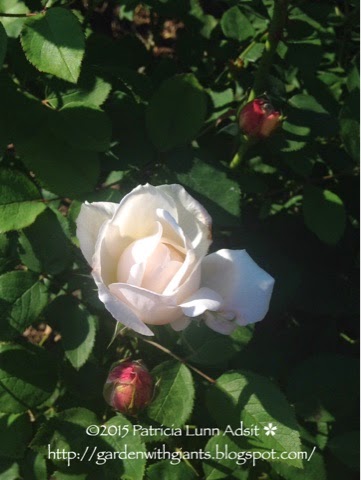
And the roses are loaded with buds, poised to pop open into a riot of colors over the next few weeks. As usual, the winner of "first bloom" in the Rose Garden is the David Austin rose "Susan Williams-Ellis." Although small by comparison with most of the so-called English roses, SWE has proven both hardy and reliable...and we are always assured of having white roses in bloom to honor the memories of our mothers, Edith and Maryen. 


Around the path from SWE is this Winchester Cathedral (also white, but with a pink edge, denoting its "Mary Rose" parentage)...


...and this Abraham Darby (on our lone remaining AD bush...having lost one to Rose rosette disease and one to winter damage). 


What you may not be able to see is the beautiful brown mulch that Mr. T spread last weekend in the Rose Garden...with Winston's help, of course. Along with black mulch to mark the paths, this brown mulch makes the roses really stand out.


So, How Does Our Garden Grow?

  • This week, I planted Clemson Spineless 5195 okra in Row #2, as well as Nanking Green cotton seeds. Many of you will remember, I got my first few colored cotton seeds from the 2011 Seed Exchange at Old Salem; the seeds I planted yesterday were descendants of those, hand-ginned and saved in the fridge over the winter. I will get a couple of containers of sweet potato slips (probably 18 in all) from Soviero's Tri-County Garden Center and plant those just before the next rainfall. The landscape fabric I used last year for the sweet potato row...complete with perfectly-spaced holes...is already pinned to the north end of Row #2 (which Mr. T tilled a couple of weeks ago), just waiting to receive the slips.
  • I planted seeds of yellow and zucchini squash; Sweet Slice and Straight Eight cucumbers; cantaloupes; and three kinds of watermelons (Jubilee, Sugar Baby, and Charleston Grays) on Row #3. The cukes will grow up the latticework trellis again this year, under which I transplanted 6 pots of basil. I put tomato cages around the squad seed hills and added some seeds of the Empress of Indie nasturtium And we are trialling growing the melons on either side of a 5'x35' fence, placed in the center of the north end of the row.
  • We also put a fence down the north end of Row #4 to accommodate the green beans. I planted seeds of Kentucky Wonder pole (both white 191 and brown seeds) and Garden Bean Advantage. Then, I created a three-row bed for Fordhook 242 Lima beans on the south end of Row #4 (calling it Dixie's Bed, like last year...;-), along with a bean tower, planted with the gigantic seeds of the Garden Bean Tenderstar, a runner type from England.
  • The tomatoes, eggplants, and peppers in Row #1 are growing well. In fact, there are yellow flowers appearing on several tomato plants already! Unfortunately I also see some lesions appearing on a few of the tomatoes, too. It's time to trim up the lower branches of the tomatoes (up to the first flowering branch), remove any suckers (rooting the more promising ones), give them a second dose of Tomato Tone, and mulch them with straw. I will also dust all with Dipel to ward off the tomato hornworms.
  • Not to be forgotten, over in the Raised Bed garden, in Box #1, I dusted the broccoli and cabbage plants with Dipel after noticing a few holes in the leaves (of the cabbage, mainly) and a single green worm. Where there is one visible worm, there are probably many more I can't see. I also dusted the beans growing in Box #2 and The Center Square with Dipel after seeing some cutworm damage. The lettuces in Box #3 look great, as do the carrots, spinach, and beets in Box #4. I noticed some "volunteer" tomatoes in Box #4 (again this year...no doubt from the Sun Golds there last year), so I thinned out all except the three in the middle of each 3x3, around which I placed tomato cages. I know, I know...this flies in the face of all gardening wisdom (hybrid tomatoes don't come back "true;" you should never grow tomatoes in the same place year-after-year, etc.), but I figure "what have I got to lose?" They are free plants...let's just see what happens.

Remember I told you in my last post that May is Melanoma/Skin Cancer Detection and Awareness Month.     I heard back from my dermatologist about the biopsy she took a week ago, after removing a suspicious mole on my back. Calling it a "dysplastic nevus with mild dysplasia," she said that she wants to observe it for any changes in the next three months. She also said that I should stay out of the sun from 10:00-4:00 each day; always wear sunscreen with a minimum 30 SPF; and wear protective clothing (long sleeves, hat) and sunglasses. I know I should not be surprised since I fit the description of someone at-risk for skin cancer (fair hair and skin; sunburn-prone as a child; works outside; and family history of skin cancer), and I am thankful that I got the next-to-the-best possible report she could have given me (the best being "it's absolutely nothing...go on about your business;" the worst being "it's definitely melanoma"). And, I am going to have to make adjustments around that "10-4" restriction. But I frankly am counting myself one lucky ducky!

Happy Hoeing!

Tuesday, April 21, 2015

April Showers

Today, we had a break in the rain...hooray! I sure hope the water table is making a comeback with all this moisture falling from the skies.
The 2015 Garden begins to give!


Here's the wrap up on the Way Back Gardens from April (look below for upcoming May activities...:):


Things have been rolling right along, with lots of progress in all the gardens.  I got a nice cool season garden planted in the raised beds of the Box Garden, and then eagerly tackled the warm-season planting checklist for the Kitchen Garden, following the average last frost date for our area (typically quoted as being April 15). Since the first two weeks of April have been warmer than usual, I took a chance on getting many of the tender transplants and seeds in the ground, although I am prepared to still have to make a mad dash to cover some tender tomatoes, peppers, and eggplants, along with the boxwood basil (in the photo, right) should the weather forecast turn chilly.

I'm happy to report that I got fifteen tomato transplants in Row #1 of the Row garden, along with ten pepper plants and two eggplants...in spite of all the help I received from Abbie and Winston (pictured, below). I planted three each of Park's Improved Whoppers, Juliets, Beefsteaks, and Celebrities; and one each of German Queen, Red Beefsteak, and Better Boy. I've also planted a Bush Goliath in a container on the deck. I remembered that when setting out tomato plants, to set up stakes and cages so as not to disturb the roots later. I also reused the landscape fabric I used last year, having already cut the X-shaped holes in the fabric at just the right distance for planting tomatoes and peppers.


I planted two each (sweet) green bell, yellow bell,  red bell, and purple bell peppers; and one each of Tabasco and Dragon (hot) peppers. I still have seedlings of Better Boys, Park's Improved Whoppers, Cherokee Purple, and Black from Tula, along with Orange Blaze, Mariachi, and Fish Peppers. These will all be ready to go into containers in a couple of weeks, about the same time I plant lima beans, sweet potatoes, okra, and cotton.

Although I missed the April 15th date ("pay your taxes, plant your corn"), I did get four rows of Silver Queen corn into the (muddy, sloppy) rows in the caged Block Garden. Fingers crossed the seeds germinate! I also got seeds planted for pole beans and bush beans in a couple of the raised beds in the Box Garden, joining two kinds of broccoli (pictured below), red cabbage, carrots, spinach, beets, several varieties of lettuce (pictured below), and (for the first time) potatoes. I had a few seed potatoes left over after I planted the grow bags, so I thought I'd trial them in a raised bed "just to see how that would work."


This year, Mr. T built me a raised bed to dedicate as an herb garden, next to the area dedicated to the asparagus raised bed. While I include herbs here and there all around the Way Back, I think they are pretty enough to be stars of their own show.

We have been enjoying our asparagus, harvesting a few stalks on nearly a daily basis, since just after Easter. I didn't get into the garden for a couple of days during the rains, and a few stalks grew too tall and tough. But, it's nice to be realizing the fruits of our labors several years ago.

First asparagus shoots 2015

Rounding out the report from the Kitchen Garden, I'm happy to see that the garlic (planted in the former home to the sweet potatoes and the onions (planted at the ends of all the raised beds in the Box Garden) are all growing and looking great.

The blueberries have already flowered and are fruiting up nicely in the Berry Patch. We also are seeing lots of strawberries, even though we probably should have been more diligent about weeding and mulching the bed; but honestly I don't remember seeing this number of potential fruit before. I pruned the grape vines and the blackberries rather lightly this Spring, and they are all greening up grandly.

I'm proud to report that all the trees in the Orchard flowered this year...no frost or freeze damage! Hooray. I need to spray the trees after the last of the apple trees finish flowering to ensure some protection against the summer onslaught of pests.

And we finally got the last of the roses we'd planned to move from the back yard to the Way Back planted in the Rose Garden: Mister Lincoln, JFK, and a Chrysler Imperial. We had to remove an Abraham Darby due to suspected RRD, making a total of four roses we have lost to this disease (of which there is no cure...only removal). We planted two more hybrid teas (Pink Peace and Chicago Peace...both from Home Depot) and a Duchesse de Brabant (from Antique Rose Emporium...in memory of our departed Duchess) in containers, and that should do it for planting for this year...except for the perennials and annuals for accents, of course. There is ALWAYS an "except for...," isn't there?

So, here's what's on our 'To Do' List for May*:

Kitchen Garden:
·         May 1st is the beginning of the recommended planting time for bush lima beans (through July 1st), okra (through May 31st), and both sweet and hot peppers (through May 31st ).  May 15th marks the date to begin planting sweet potatoes (through June 15th).  I've got a good start on this one.
·         Continue planting pole beans (through July 1st), cantaloupe/muskmelons (through June 1st), sweet corn (through June 1st), cucumbers (through May 15th), pumpkins (through June 15th), summer and winter squash (through May 15th), tomato plants (through July 15th), and watermelons (through June 1st). I currently have transplants-from-seeds almost ready to go in my Bio Dome seed starter in the kitchen.
·         Be sure to remove any suckers on tomatoes to encourage the plant’s energy be used for larger fruit rather than side shoots. (I always attempt to root the suckers; many times I'm lucky and get a freebie tomato!). And, take the precaution I learned while in the Seeds of Change at EPCOT: remove the lower branches on tomato plants to help prevent diseases such as blights that are transferred from water splattering off soil onto leaves.
·         When planting beans (pole and/or bush) and corn, make successive plantings every two weeks to ensure a longer harvest.
·         Plant basil and dill directly in the garden this month.

Orchard and Berry Patch:

·         Fertilize blueberries, blackberries, and grapes this month.  Read more about it in the NC Cooperative Extension publication Grapes and Berries for the Garden.

Rose Garden (and perennials and annuals):

·         To prevent black spot on roses, continue a weekly fungicidal spray regimen, if you don't use the 6-week systemic variety.   The latest research says NOT to remove black spot infected leaves UNTIL you don't see anymore green...thereby giving your rose bush all the help it needs in continuing to produce chlorophyll.
·         Prepare beds for summer annuals such as petunias, marigolds, and zinnias; a location with 6 or more hours of sun each day is ideal.

 
Flowers, Shrubs, and Trees in the Front and Backyard gardens:
Azaleas blooming in the back yard
 
·         May is time to plant summer-flowering bulbs, especially caladiums and gladioli. I already have some glads coming up inside a "protected" area, so they seem to have made it through the mild winter we had.


·         Prune and fertilize Spring-flowering shrubs such as azalea (pictured, left) and rhododendron after they have bloomed. We NEED to make this a hard-prune year, as ours are all rather wild looking.
 
·         Remove broadleaf weeds from all landscape planting areas. If left to grow, they will rob water and nutrients from your plants. We have brought nearly 200 bags of hardwood mulch onto our property, spreading yards and yards by cubic yards of the stuff.  We still have lots to spread in the Rose Garden.

Lawns and Grasses
·         According to the Home Lawn Calendar for May from the Center for Turfgrass Environmental Research and Education at NC State, mow tall fescue lawns at 3 to 3 ½”, and at least once each week.  This article also encourages grasscycling, which is the practice of leaving grass clippings on the lawn.  “Grass clippings decompose quickly and can provide up to 25 percent of the lawn's fertilizer needs.”  We actually use the clippings from the Way Back (around the Orchard and the Berry Patch) to "feed" the compost piles.  Good as gold!
·         Lawns need 1 to 1 ¼ inches of water per week.

Other             
  • Take some time to enjoy the butterflies, honeybees, and hummingbirds!  We have a small raised bed Pollinator Garden in the Orchard, with a bird bath; I see that the bee balm, lavender, and pineapple lilies are returning this year...yeah! Soon, I will direct-seed zinnias to fill out the spaces.
  • Move houseplants out-of-doors when the nighttime temperatures are consistently above 50 degrees. We are waiting to move the lemon trees out of the plasticized screen porch...just for their protection, since we are still getting some 45-49 degree nights.
  • Be sure to incorporate finished compost into the garden,  and then begin a new compost pile. We have a wonderful barrel-type composter that Mr. T rolled out to the Row that will host the sweet potatoes and okra, so we are ready to begin the process again. Learn everything you ever wanted to know about the subject from the NC Cooperative Extension publication:  Composting: A Guide to Managing Organic Yard Wastes.

Remember, May is Melanoma/Skin Cancer Detection and Awareness Month.  Before you dash outside to your May gardening activities, put on a hat, sunglasses, and adequate sunscreen protection. It's also a good time to visit your dermatologist for a skin check. I'm getting a jump on that this Friday!

Happy hoeing!


==================================
* This May To Do List is updated and revised from an article I had published on GoGreenTriad.com in 2011.

Wednesday, August 6, 2014

Days of Summer

Alex Trebeck: Lazy days of Summer.
Me: What is NEVER the answer to a question about a garden in August?


Summer is in full swing in The Way Back and brings with it a change in gardening chores for the month of August. As the thermometer soars, enthusiasm for gardening activities typically wanes...at least in the heat of the day. July and August are our hottest months, so we usually don't start a lot of new garden projects...although we do tend to talk about plans for this or that while taking more frequent cooling-off breaks. Still, there is always a mountain of maintenance to-do's in a Summer garden. Plus, we take the first steps for our Fall vegetable garden from mid-July through mid-August.

The best time to do any kind of gardening or maintenance is in early morning when it hasn't gotten so hot, or late in the day after the sun has dropped toward the horizon. Years ago, I promised my mother (who worried about the potential for heat stroke...since that's how her Grandfather Keaton died) that I would "try my best" to follow a rule of "Noon or Ninety, whichever comes first," coming inside to cool off when the clock reached 12:00 or the temps topped 90. In addition to paying attention to the time and temperature, I dress appropriately, keep a cooling cloth (made from strips of an old cotton T-shirt, soaked in cold water) around my neck, take more frequent breaks, drink plenty cooling beverages (water would be best, but I lean toward iced tea), and remember to use sunscreen and bug spray. 

Here's the Garden report for early August:

Kitchen Garden —

• What can I say? I admit I spend the majority of my time here in Summer. I take my morning coffee walk around the garden not only to see what is growing; enjoy the fruits of our labors; snap pictures to document and share; and pick what has ripened; but also to spot problems with weeds or pests before they get out of hand. "Managing by walking around" I call it.

• In Row 1, the okra (mainly Clemson Spineless, joined by a few Burgundy, Green Velvet, and Dwarf...all seed from the Old Salem Seed Exchange in 2013) is starting to produce pods. I have fewer plants than last year, so I hope I will be able to keep up with the harvest (which just overwhelmed me in 2013)!

• Row 1 is the home to my stand of heirloom Nanking green cotton. I hand-ginned the seed from the boles harvested in 2012 and planted 24 "hills," using 3 seeds to a hill (making allowances for two-year old seed). I had a fantastic germination rate, resulting in 1-3 plants per hill. Of course, I have had to replant a few hills due to the dogs using this portion of the garden for their enthusiastic romps, but that was easily done. BTW, someone recently asked me why I was growing cotton? I replied "because I got the original seed from the Old Salem Seed Exchange (and I feel an obligation to grow some and give back), because it represents my own heritage, because it produces one of the prettiest flowers around, and because the growing conditions are right...not to mention that I want to raise enough cotton to hand-spin enough yarn to knit SOMETHING!"

• Also in Row 1, the Beauregard sweet potato vines are running well. This year, I am trialing growing sweet potatoes under black landscape fabric, cutting holes to plant the initial 18 slips. They look happy with this arrangement! My hope is that the fabric will help keep the clay soil moist enough to alleviate its  hardening into a long, solid brick...and make it easier for the tubers to form and then dig. Time will tell whether it is successful. UPDATE: what has eaten the leaves off the sweet potato vines?! We are surmising we may have a ground hog (our neighbor says he has seen one); whatever the critter is, he/she left the vines and just ate the leaves. How odd!

• In Row 2, the cucumbers (Straight Eights and Boston Pickling) growing on the latticework trellis), yellow squash, and zucchini (both kinds of squash are being trialled in tomato cages) are all producing profusely. For the most part, the cukes I am collecting to have enough for pickles; I have made some favorites (at least for me) like marinated (in vinegar and sugar) cucumber and onion slices, veggie cream cheese spread, and gazpacho. I do try to pick the squashes while they are still small and tender, but sometimes they just get away from me. That's when I find baseball-bat sized zukes hiding under the giant leaves.  Can you say zucchini bread? 

• Squash borers and squash bugs can both be fatal to squash, zucchini, and pumpkin plants, and they will attack melons, cucumbers. I check the undersides of Learn more about these pests and how to manage them from this Pender Gardener article: http://pender.ces.ncsu.edu/index.php?page=news&ci=LAWN+76. UPDATE: it looks like the squash vine borers have arrived. Several of my squash plants seem to be showing signs of the frass around the base of the thick vines. Also, because of all the rain and high humidity, the conditions are excellent for mildew. Sigh.

• Row 2 is supporting one of my experiments for 2014: using tomato cages to trellis my melons. [I'm doing this experiment in response to the disaster in the melon patch in 2013, when a raccoon (or something) ate its way through every single melon.)] Since the cantaloupes are vining slowly, they have been easy to train. I only have one 'lope, which I have supported with a zip-tied, vented gallon milk jug, which has drainage holes in the bottom. The excessive temperatures in late June stalled the development of more flowers, so I just have to wait until they recover.

The watermelons are proving more difficult. All three varieties (Crimson Sweet, Sugar Baby, and Jubille) are vining well...perhaps too well. All have produced flowers and fruit, with Crimson Sweet winning the numbers game here. I knew the individual melons would need support when they begin to gain weight, so I cut huge swaths of old, summerweight row cover cloth into slings (or hammocks, as Thomas said) and used clothespins to attach them as supports to the ripening melons. Seems to be working in most cases, with the notable exception of the Jubilees...which can weigh 25 pounds. We found the largest of the developing Jubilees on the ground yesterday, after it had ripped through a hole in its sling and snapped off the vine. I picked the two largest CS and Jubilees and one SB (as you can see in the photo below). UPDATE: flowers have returned to the melon vines after a brief hiatus. Several melons are forming at the ends of the vines, so I am bringing out the plastic pots (overturned) to try to provide some protection.

• Row 3 is home to most of our bean crop: Kentucky Wonder and Garden Advantage are planted on the 30' long bean "fence" (made with two 5x15' net trellises strung over 3 6'-steel fence posts), Scarlet Runners are planted on the bean tower, and Fordhook limas are planted in a three-row bed. Of all those mentioned, the limas are doing the best (which is great because they didn't even flower last year, much less make a crop!). We have suffered repeated losses to either cutworms or bunnies...or both...along the bean fence. Still I kept watering the stubs, and many sent out a second set of leaves on alternate stems. The KY Wonders are beginning to flower (finally) so we may get a crop yet...if I can keep the Mexican Bean beetles (which were a scourge in 2013) at bay. I have used neem as a precaution against all other pests in this row, being cautious to use in the late evening to avoid damage to pollinators. UPDATE: the Garden Advantage bush beans have switched into high production mode. Hooray!


• Dominating Row 4, the tomatoes are ready...finally! We have been picking (and in many cases eating right off the vine) Sun Golds for nearly a month now...both from the one transplant I purchased from Burpee and from the three volunteers I have been trialing in the raised bed, just to see what (if anything) these offsprings of a hybrid would produce. As of this week, I have been picking the almost ripened Beefmasters and Park's Improved Whoppers...6 nice ones today. I say "almost ripened" because we suffered a loss last week of our very first almost ripened Black Krim, when I discovered a squirrel (or some critter) had beaten me to it. Brazen beasties! 


And then Thomas discovered our turtle has returned. He seemed to be enjoying a couple Romas that had fallen off the vine. We don't think a turtle capable of reaching up and pulling the produce down to his level...and at least when a turtle eats, he cleans his plate!

As tomato plants continue to grow and produce, I try to keep the soil around the plants (which is mulched in mushroom compose topped with leaf mold) consistently moist. Inconsistent watering is the reason tomatoes develop unsightly cracks. Also, blossom end rot (those awful black spots covering the bottom of your tomatoes) is most common on tomatoes but can also affect peppers, squash, and melons. BER is the result of low calcium in developing fruits and is most commonly caused by uneven watering. For some reason, we've lost several of the Beefmasters to BER, but only one PIW. 

• The peppers in Row 4 are growing well and starting to ripen, yielding a couple red pimientos, a golden Orange Blaze, and a couple mild bananas. The hot Cherry Poppers (whose peppers grow up rather than down on the stem) are going into high gear now. I burned my tongue on one of the seeds when I was putting up some in a pint jar (with hot vinegar)!

• I've seeded the Fall garden in the raised beds in the Box Garden: broccoli, cabbage, spinach, beets, carrots, and lettuce. Have to remember to keep the beds moist, since the temps can do a great deal of damage to the germinating seeds of Cool Season crops

• The Block garden has corn and pumpkins inside the fence, with the latter growing faster than the former. I struggle to keep up with removing eggs laid on the pumpkin leaves by the squash bugs...who seem to prefer pumpkins to squash at this point. UPDATE: I planted garden (English) peas around the outside of fence.

• The 3 rows of pink-eye purple hull ("Southern") peas have done fairly well, despite being in the direct path of the dogs' romps. They have stopped flowering, but I hope cooler night temps might encourage another flush of peas.

Here're the latest harvest snap:


Orchard —

• Since ALL of our fruit trees were adversely affected by the late freeze in April, there will be no fruit this year. So sad.

• The Pollinator Garden is looking good! Zinnias have filled in, as have the marigolds. A couple of surprise sunflowers have sprung up; that's one of them in the pic above. And the pineapple lilies (new in 2013) have bloomed! 

Berry Patch —

• Blackberries are winding down and need to be pruned to remove the canes that have just produced this year's fruit. To encourage branching on the new canes (which will produce next year's berries), we cut back the vigorous, new growth two or three times for greater fruit production. UPDATE: Thomas cut back the canes that just fruited.

• Blueberry bushes also need pruning now that their harvest is complete. Thomas cleaned out the weeds from the blueberry boxes (as they are planted in raised beds). I need to prune the bushes and and mulch again with a nice layer of leaf mold.

• The 2 Concord grapes have put on too much new vine growth, along with a record amount of fruit production (see pic). Consequently, we had to do some repair work on the fence-trellising system after a severe thunderstorm in late June. The newest grapes (3 Reliance and 3 Flame) are passing their first formative year without much assistance from us; we are simply allowing them to develop good root systems in hopes they begin to flower and fruit next year. Here're the Concords:


• I spent a cloudy morning rejuvenating the strawberry bed, cutting off numerous runners and weeding. I dosed the remaining "Mother" plants with earthworm casings (fertilizer) and mulched them with mushroom compost. I am attempting to root the "daughter" runners in two flats and several hanging baskets; those that "take" will be used to create a new bed this Fall. UPDATE: the runners planted in baskets have done much better than those in the flats.

Rose Garden —

•  According to "The Pruning Specialist" by David Squire, good results have been achieved by using electric hedge trimmers to prune bush roses. Intriguing. While I balk at using this technique with my hybrid teas, miniatures, floribundas, or grandifloras (or on any rose in winter dormancy), I saw promise in managing the exuberant summer growth on my David Austin English-style bush roses...which is usually an overwhelming, two-day job to tackle by hand with pruning shears and loppers. When I suggested 'hedge trimmer' to Thomas, he embraced the idea with great enthusiasm: more power (say that last phrase with a Tim Allen/Home Improvement-inspired laugh)! I'm happy to report that all 33 DA's were successfully Summer-pruned into shape with the Black&Decker...and all the debris loaded into the yard waste toter for disposal...in less time than it took me to hand-prune the 33 HTs, Minis, Fs, and Gs. The Rose Garden looks neat and clean, albeit a bit bare at the moment, but I have high hopes we will see some of those "good results" soon.

• Additionally, mid-July was the time to feed all our roses, as well as get caught up with controlling pests. At this feeding, I used a combination of 1 cup Mills Magic rose food (ordered online here: http://www.millsmix.com/store/index.php?main_page=product_info&products_id=122 ; yes, it's expensive but a truly excellent product...and shipping is included, which is good because I order 40# at a time) and 1 capful granular Bayer 3-in-1 (which contains insect and fungal pest control as well as some fertilizer) per bush. I have also sprayed the roses with neem oil to help with pest control, although I believe hand-removal of Japanese beetles (knocking them into the soap-&-water mixture in my coffee-canister Kill Jug) to be altogether satisfying, safe, and moderately successful. I am currently researching the Bayer product with an eye toward changing this part of my regime in the future, but for now I will use up my present supplies for 2014. 

• The Shasta Daisies I started from cuttings in 2013 are looking beautiful! They have created almost a solid hedge of green leaves topped with flowers bearing large white petals and bright yellow centers. Not only are the daisies perfect companion plants in a rose garden, they make excellent cut flowers to add to summertime arrangements. Other companion plants that are doing well in The Rose Garden include coreopsis, lambs' ears, liriope, Autumn Joy sedum, and dianthus (pinks). The Black Knight buddleas I started from cuttings are nearly six feet tall, and two volunteer giant sunflowers have also added height and color to this area of the Way Back. I replaced a couple of casualties in containers, lost to the cold winter (most regrettably, the agapanthus) with two different Japanese maple trees. Interesting to note: so far, Japanese beetles have not shown any interest in the Japanese maples.

• We have reclaimed the patio in the Rose Garden by doing a bit of furniture rearranging: the rockers moved from the front porch to the patio; the glider moved to behind the Pollinator Garden in the Orchard; and my readers chair moved to the front porch. Fruit basket turnover, right?

Front Yard —


• We tackled the chore of dividing the iris along the front walk and around the lamppost, as you see in the pic above. Here are the instructions we followed when we did that:

"Pick a day in late July or early August when the temperatures are below 90 degrees.   Irises grow from rhizomes, which are elongated stems that grow horizontally below ground and have roots attached to them.  Using a garden fork, lift the whole plant out of the ground. Snap off or use a sharp knife to cut off the vigorous ends of the rhizomes.  Make sure that there are roots attached to each portion.  The center portion is no longer productive, so you can throw it away. Before re-planting, inspect each portion and discard any that indicate the presence of Iris borers or soft rot.  Cut the foliage on healthy rhizomes to about 8 inches.  They prefer dry feet, so replant them 8-10 inches apart in well-drained soil just at or slightly below the soil line.  Don’t pile mulch over the roots.  Mulch can retain more moisture than the rhizomes can handle."    

• We replanted several fans, gave some to our neighbor, and still have a tub full for Missy M's new garden. Thomas moved a crepe myrtle sapling and also spread several bags of black mulch around that area.

• I cut back the stems of the Gethsemane mums down at the mailbox, before they began to form flowers. This allows them to delay flowering until fall. Typically you want to finish this chore by July 15. Never one to squander the opportunity to get new plants for free, I started new chrysanthemums from the cuttings. (Those started in early July should flower this fall.)

Here's how I did it: "Take a four- or five-inch cutting. Pinch off the leaves on the lower one third of the stem. (Stem cells at the base of each leaf produce the most active growth. New roots form there easily.) Remove leaves further up the stem also, leaving three or four small leaves at the cutting tip. Once leaves are removed, put each stem section into a container of water while preparing more cuttings. Pre-moisten potting mix or seed-stating mix in a wide-mouthed pot or planting tray. Use a pencil or dibble to poke holes in the soil about three inches apart. Dip the stem where the bottom leaves have been removed into rooting hormone such as Rootone. Stick one cutting in each hole. Push dirt against the stem to make good soil-to-stem contact. Place pots or a tray with cuttings in bright shade (no direct sunlight). Allow about four weeks for roots to develop. Keep the soil evenly moist while new roots form. For a week or two, expose the container to brighter light but not to full afternoon sun. Don’t let the soil dry out. Plants can then be transplanted to the garden or into larger pots. Keep new transplants well watered for a few weeks. Shield from afternoon sun for two or three days."

Whew! I could use a day off! But there's no rest for the wicked...and the righteous gardener doesn't need any!


Wednesday, May 7, 2014

May Has Arrived...Finally

Crazy weather this year has made for a slow start in the Kitchen Garden...and much loss in the other gardens. Sigh. 

Of course, I can't blame being behind the times all on the weather. There was my cataract surgery and recovery...then came the 12 days away from home when we went to Louisville...and then I spent the past week attending the NCEMGVA Conference in Winston-Salem. And while I was learning more about gardening (but not actually gardening), the weather flipped straight into Summer...91 today. Double sigh. 

I did want to share some of the fruits of our labors with you. Here's a picture of our first cutting of broccoli, along with some asparagus. 


We had cut some yesterday to grill along with some salmon steaks, so the pickings appear slim; still, the 4-year old asparagus bed is yielding more than enough for the two of us. Out in the Raised Beds, our lettuces (red and green romaine, along with Buttercrunch and Red Sails) look fabulous, and our spinach is quite healthy and productive. We probably have enough onions to supply a small restaurant, because I am trialing using onions extensively in the (red) cabbage bed to help reduce the number of cabbage worms. Seems to be working well. And the carrots and peas are finally joining the party. So, the cool season crops are doing well, even with their slow start to 2014. 

But I'm almost embarrassed to report we haven't put in a single Warm Season transplant or seeded a single crop in the Row Garden yet...and it's almost Mother's Day. Triple sigh.

Time to get down to business! Here's what's on our 'To Do' List for May*:

Kitchen Garden:
·         May 1st is the beginning of the recommended planting time for bush lima beans (through July 1st), okra (through May 31st), and both sweet and hot peppers (through May 31st ).  May 15th marks the date to begin planting sweet potatoes (through June 15th).  I've got my work cut out for me, don't I?
·         I'll also be planting pole beans (through July 1st), cantaloupe/muskmelons (through June 1st), sweet corn (through June 1st), cucumbers (through May 15th), pumpkins (through June 15th), summer and winter squash (through May 15th), tomato plants (through July 15th), and watermelons (through June 1st).
·         When setting out tomato plants, we set up stakes or cages so we won’t disturb the roots later.  I try to remove any suckers to encourage the plant’s energy be used for larger fruit rather than side shoots, and I remove all branches below the first flowers to encourage a string central stem...and to discourage pests. (I always attempt to root the suckers; many times I'm lucky and get a freebie tomato!)
·         We'll be planting beans (pole and bush) and corn, make successive plantings every two weeks to ensure a longer harvest. I did get some English-style runner beans and some Kentucky Wonder pole beans planted around the tuteur last weekend. We will need to set up a bean "fence" in Row #3 this year (factoring in crop rotation, by moving everything one row east each year...alaman right!) to provide support for the main crop of Kentucky Wonders. 
·         I've started seeds and hope to plant basil and dill directly in the garden this month. I took cuttings of mint and divisions of chives from Missy M's herb garden, and I want to get them settled into their new abodes here in HPNC.

Orchard and Berry Patch:

·         I will fertilize the blueberries, blackberries, and grapes this month. All are looking healthy and show signs of a great year...fingers crossed! Read more about it in the NC Cooperative Extension publication Grapes and Berries for the Garden.
·         I'll need to spray the fruit trees with the first spray after fruit set. Sadly, the extremely cold winter and the late freeze on April 14-16 probably means a rather anemic crop. There will be no pears or plums, and few peaches and apples...if the squirrels don't get them again this year. The only heavy fruit-set has occurred on the crabapples. 

Rose Garden (and perennials and annuals):

·         To prevent black spot and control pests on roses, I will use the 6-week systemic 3-in-1 variety.   The latest research says NOT to remove black spot infected leaves UNTIL you don't see anymore green...thereby giving your rose bush all the help it needs in continuing to produce chlorophyll.
·         We will prepare a couple new beds for summer annuals such as petunias, marigolds, and zinnias...possibly by the fence, so there will be a good backdrop.

  • Additionally, on our list is to document all the roses we lost to weather this year. I already know about the following: 3 Always and Forever, 2 Cinnamon Girls, 2 First Prizes, and one each Kordes Perfecta and Pope John Paul. We also had to remove my absolute all-time favorite floribunda, Mardi Gras, which was showing signs of rose rosette disease (which is always fatal). Here's what it looked like in years past:


Flowers, Shrubs, and Trees in the Front and Back yard gardens:

·         It’s time to plant summer-flowering bulbs, especially caladiums and gladioli. I already have some glads coming up that seem to have made it through the winter we had.  We shall see...


Our rhodo in full bloom in early May.
Time to fertilize and prune after blooming.


·         We (read this 'we' as Mr. T) need to remove broadleaf weeds from all landscape planting areas. If left to grow, they will rob water and nutrients from our plants, and they make the gardens look so untidy in any photos. He is a weeder-fanatic, so naturally I encourage him to play to his strengths!

Lawns and Grasses
·         According to the Home Lawn Calendar for May from the Center for Turfgrass Environmental Research and Education at NC State, we need to mow tall fescue lawns at 3 to 3 ½”, and at least once each week.  This article also encourages grasscycling, which is the practice of leaving grass clippings on the lawn.  “Grass clippings decompose quickly and can provide up to 25 percent of the lawn's fertilizer needs.”  We actually use the clippings from the Way Back (around the Orchard and the Berry Patch) to "feed" the compost piles.  Good as gold!
·         Since lawns need 1 to 1 ¼ inches of water per week, it's time to get the irrigation system going for the year. 

Other             
  • We will take some time to enjoy the butterflies, honeybees, and hummingbirds! As you know, I love taking loads of photos!! To try to keep our property productive as well as pretty...and to protect these beautiful creatures...if I need to use a pesticide, I use Neem Oil, which is marketed as an Organic spray. Still, it is still toxic to bees...so I don't spray in the morning when bees are most active.
  • We have moved all the plants that wintered on the plasticized screen porch out to their summer spots, including the three citrus trees. The Improved Meyer Lemon and the Orange trees are both flowering profusely, while the lemon tree I started from seeds from a lemon from my Aunt's house in Arizona still hasn't flowered...but is beautiful and green nonetheless. We have moved this big tree in its container across state lines a couple of times now, so it's with us to stay no matter.
  • After incorporating the finished compost into our garden, we began a new compost batch in our barrel. I hope to get a worm or two or ten working this time, so must remember to feed and water the pile regularly. 

    Remember, May is Melanoma/Skin Cancer Detection and Awareness Month.  Before you dash outside to your May gardening activities, put on a hat, sunglasses, and adequate sunscreen protection. Well, I can say with certainty that I get two out of the three!

    Happy hoeing!


    ==================================
    * This May To Do List is updated and revised from an article I had published on GoGreenTriad.com in 2011.