Showing posts with label Links. Show all posts

Monday, April 2, 2012

Third Time's the Charm

It's Year Four for the Way Back Garden...and Year Three for my Gardening with the Giants blog.  Just as the start of Spring brings hope to every gardener and opens the possibilities of the coming months, so too has this Spring brought hope and possibilities to me.

Reclaiming the Way Back
100 bags of mulch
Paths done!
Only 50 bags of mulch to go!!


I am happy to report that, after a sad and unproductive 2011, this year is looking fantastic!  The Way Back went neglected and unattended last year, while our energies and efforts were directed to helping Mom in the final steps of her journey (the details of which I posted on the family blog The Adsit Adventure). But, in the first quarter of the year, we are making great strides at reclaiming our quarter-acre of paradise.

So far in 2012, we have:

Mr. T fills the potato grow bags
  1. Redesigned the Four Year Plan, designating the lower-left quadrant of the Way Back as the Kitchen Garden and the lower-right quadrant is now the Rose or Cutting Garden (we call it both...:).  The upper-left continues to be designated the Orchard and the upper-right continues to be the Berry Patch. (To recap, the Way Back is an almost-square quarter of an acre, fenced on all sides, nestled under the transmission lines of Duke Energy...the "Giants" of this blog's title.  The only trees are on the periphery, which means we have almost full sun in this area...great for veggies, fruit trees, berries, and roses.  We are making a silk purse out of a sow's ear, if ever...:)
  2. Planted a row each of cabbage, broccoli, spinach, lettuces, carrots, and beets in the Kitchen Garden. Onion sets were interplanted with the cabbage and broccoli. All are doing well, with the exception of the carrots...which have been slow to break through the crusty clay soil...and I still have the cabbage and broccoli under row covers to protect them from pests.  Weeded the asparagus bed, which is in its second year and beginning to produce shoots. 
  3. Planted 6 grow bags (purchased from Gardener's Supply; photo, above/right) of Yukon Gold potatoes (from seed potatoes, purchased at Tractor Supply) and one row of Russets (from potatoes sprouting in my kitchen, originally purchased at Harris Teeter grocery...:).
  4. Used over 100 bags of mulch (see "before"  and "mid-task" photos, above) to re-mark the paths and the Rondel, which is what we call the center oval where the paths dissect.  Prior to putting down the mulch, Mr. T put a layer of old newspapers, covered with a layer of Preen black landscape fabric. Hopefully, this will block the grass and weeds that sprouted through the original mulch in the Rondel.
  5. Ordered, received, and planted 11 new fruit trees from Stark Bro's Nursery in Louisiana, MO, in the previously-prepped holes in the Orchard. [Mr. T had triple-tilled the holes and added several bags of leaves as compost.] We now have planted 18 dwarf fruit trees (remember, we are limited by the easement agreement with Duke Energy to trees of 15 feet or under), including two cherry trees, three pear trees, two peach trees, ten apple trees, and one crabapple tree.  All are doing well, with the exception of one of the apple trees, which is one of the ones we purchased at Tractor Supply and planted last Spring.  I think it will need to be replaced this Fall.  Meanwhile, we plan a rest area in the Orchard, with a paver-patio and a covered swing (which we got on our last Tractor Supply run...:).
  6. Ordered, received, and planted 12 new roses from David Austin Roses (3 William Shakespeare, 3 Golden Celebrations, 2 Huntington Rose, 2 Gertrude Jekyll, and 2 Susan Williams-Ellis)  in the newly-tilled and prepped Rose Garden quadrant.  Mr. T has also assembled and stained a new teak glider that will be placed on a stone-paver patio we will lay.  We will place a bird bath and a feeder across the path from this patio, so that the bluebirds will have their own Bistro near the two bluebird houses on the fence.
  7. Tilled and retilled...and populated the new strawberry bed in the Berry Patch with runners from the "old" bed (that was tilled under to create the Rose Garden). We had so many runners that I have planted strawberries in every empty pot and hanging basket I could find.  All are doing well...and many are already flowering and fruiting. 
  8. Fertilized all the blueberries (which are already flowering), the blackberries, and the grapes in the Berry Patch.  Also, fertilized the crepe myrtles and privet.
  9. Seen our first snake of the season...and lived to tell the tale about it..:)
  10. Ordered and installed 2 (of 5) cottage garden corner fences, to mark the corners of ...and the path between...the Rose Garden and the Kitchen Garden.
  11. Pruned and started the feeding of all 18 rose bushes, in the back yard and in the Rondel.  Two didn't make it through the heat of last year's summer and the (mild) winter, so I replaced them in February.  All are looking good; most have buds already!
  12. Started 4 kinds of tomatoes and fish pepper seeds in peat pellets/egg cartons.  They are now under the grow light on the screen porch (which is still plasticized).  The tomatoes are getting their first true leaves (the ones that arrive after the seed-leaves) and will be ready to move into larger accommodations (3" pots) this week.
  13. Placed...and received (while I was composing this...:) our Lowe's order for the materials to construct two patios in the Way Back and one "pad" that will run from the driveway, under the double gates, and into the back yard.  More on this in a later post.
Whew!  I'm tired just recounting what we've already accomplished! Here are a couple of shots of some of the work:
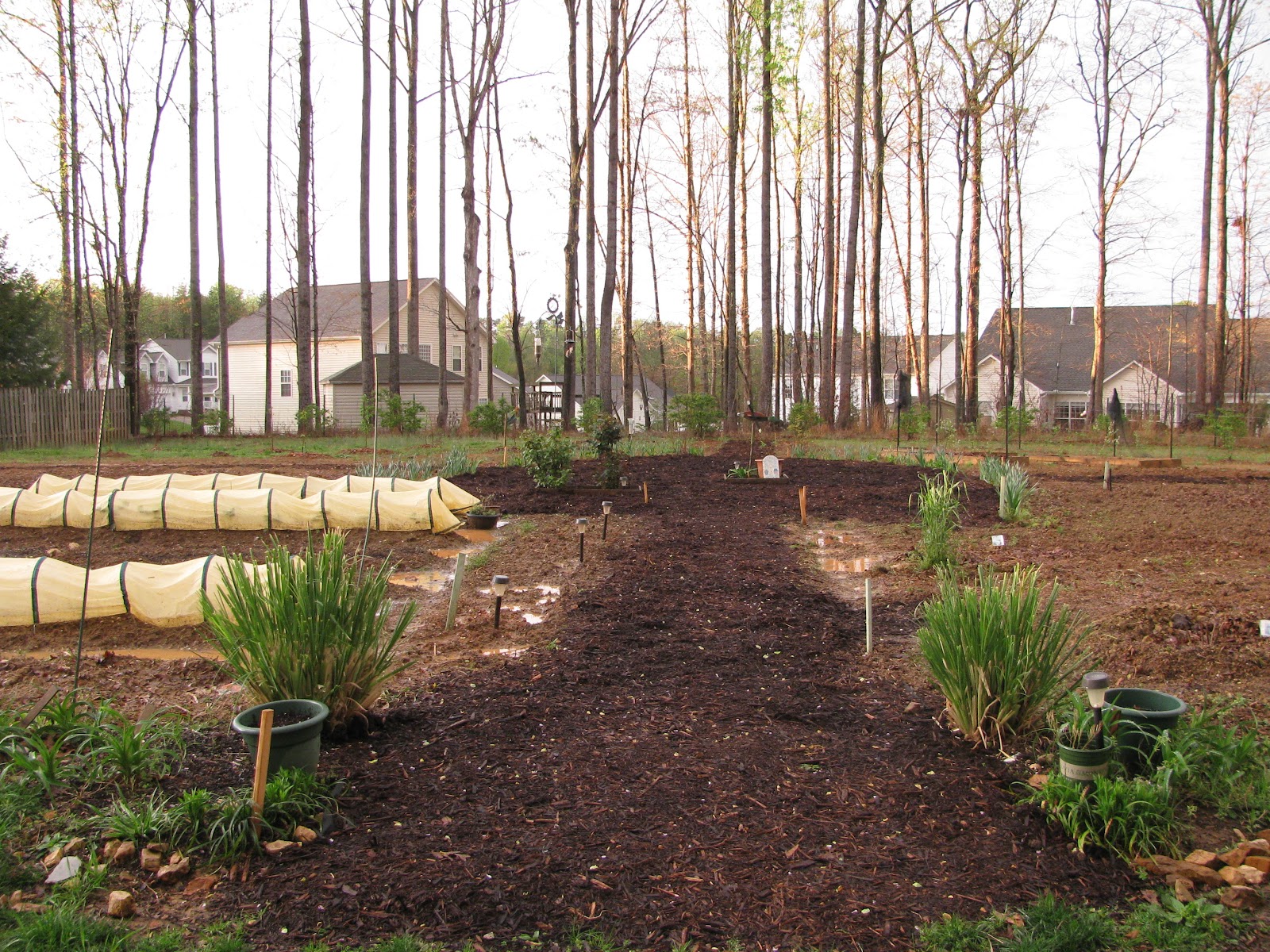
Rondel and paths are mulched in the Way Back.
Row covers on the cabbage, broccoli, and lettuce (left)

Standing in the Rondel, looking toward the Berry Patch:
Blueberries in raised beds...blackberries behind them.
New Strawberry Bed on lower right.

We have an outstanding order with Roses Unlimited for 9 hybrid teas, and another order in with David Austin for 14 more English roses...all of which are scheduled to arrive over the next few weeks.  I got several perennials at Home Depot on Friday (when we took both cars to pick up 35 more bags of mulch to create mulch rings around the fruit trees...and to cover the path in the Rose Garden), and I will be adding those to the Rose Garden to give us some color while we are waiting on the English roses to grow.  I also picked up some herbs that I shall pot up in larger pots.  I am trying Boxwood Basil this year, with the plan to use it as a border between the Kitchen Garden and the center path.

Gus says...time for a break!
I have a long to-do list for the garden for this week, but I'll save it for the next post.  I don't know about you, but I need a break after all of that.

Lemonade, anyone?

Monday, February 7, 2011

What To Do in Your Garden in February

Let's face it.  Here in Zone 7, the month of February can be such a tease.  One day (like today) it's 48 degrees.  Another day (like last weekend), it's 68 degrees.  And yet another (like our forecast for tomorrow sounds), "38 with possible snow flurries."  What's a gardener to do?

Create a checklist of things that you can do, including some indoor activities for those bitterly cold days you know are standing between you and Spring.  Before we get to the checklist for February, be sure you've done the following first:

    
    Soil testing in the veggie garden - 2011
    
  1. Create your plan, if you didn't do this in January, including your kitchen garden (veggies, herbs, and edible flowers), your orchard, your berry patch, your flower and speciality gardens (such as a rose bed, bog or wetland garden, and containers), and your lawn and natural areas.  Get some graph paper to make it easier to draw your plan to scale, or invest in a software application that will do this for you, if so inclined.
  2. Do your soil testing (photo, right) to determine what your soil needs for optimal conditions for what you plan to plant there, if you didn't do this in January.  Here in North Carolina, soil testing is free (as of today...:); you can obtain the soil test boxes and instructions from your county extension office.  Be aware that the longer you wait to submit your soil test(s), the longer it will take to receive the results.  This is the same time of the year that farmers are submitting their tests, too, so the line will be substantially longer than if you did your soil testing in December or January.  You will need to re-test every 3-5 years.
  3. Contribute to your Garden Journal on a regular basis.  Keeping a record may sound like a time-consuming chore, but it is actually a time-saving tool.  You will be able to review what you did in the past, what worked, what you would change or do differently.  You will also have access to what your garden looked like two, three, or ten years ago...without having to rely on memory alone.  Consider creating a spreadsheet to keep track of monthly chores and planting activities.  Or, use one of the one's found by an online search.  Here's a link to one by the Farmer's Almanac folks that you can adjust by entering your own zip code:  http://www.almanac.com/gardening/planting-dates/NC/High%20Point

Checklist for February, Zone 7, Piedmont of North Carolina --


First rows tilled in 2011
Peas planted
 Kitchen Garden:
  • Select seeds from catalogs as early as possible.  Some varieties do sell out rapidly, especially some of the heirlooms.  Visit websites for the most up-to-date information.   Check out the extension service for your area to find suggested varieties that do well in your climate and soil, such as the one by the North Carolina Extension Service:  http://www.ces.ncsu.edu/depts/hort/hil/pdf/hil-8103.pdf
  • When the weather permits...and the soil is dry enough to work...till a few rows to prepare for planting early Spring crops (photo, right/above)
  • According to the Wyatt-Quarles Seed Company's Seed Guide, you can plant the following, beginning February 1st:
    • cabbage plants (Early Jersey Wakefield, Stonehead Hybrid, All Seasons);
    • carrots (seeds of Danvers Half-Long or Imperator);
    • endive (Green Curled)
    • mustard (Southern Giant Curled, Tendergreen, Florida Broadleaf, Old Fashion);
    • onion sets (Silver Skin, Yellow Danvers); garden ("English") peas (Super Sugar Snap for edible pods; Early Alaska, Wando);
    • radish (Early Scarlet Globe, Cherry Belle, White Icicle);
    • spinach (Dark Green Bloomsdale, Hybrid 7); and
    • turnip (Purple Top White Globe, Seven Top for greens only, Just Right Hybrid)
  • Beginning February 15th, you can plant:
    • beets (Detroit Dark Red)
    • broccoli plants (Italian Green Sprouting, Premium Crop)
    • kale (Dwarf Curled Scotch, Early Siberian)
    • kohlrabi (White Vienna)
    • leaf lettuce (Salad Bowl, Buttercrunch, Black-seeded Simpson, Romaine)
    • head lettuce (Great Lakes, Iceberg)
  • As the end of the month approaches, you can start the following seeds indoors for transplanting later:
    • tomatoes
    • pepper plants
    • some herbs
  • If you have overwintered the plants, divide thyme and chives.
Orchard and Berry Patch:
  • Plant fruit trees, blueberry and blackberry bushes, and grape vines.
  • Prune established grape vines.
  • Prune fruit trees.

Flowers, Scrubs, and Trees:
  • Plant or transplant trees and scrubs.
  • Plant bare-root roses.
  • Divide perennials like day lilies and daisies.
  • Prune trees and evergreen shrubs; however, wait until after blooming to prune forsythia and azaleas.
  • Fertilize spring bulbs as soon as you see the leaves breaking through the ground; remember to leave the leaves on daffodils, even after the flowers bloom in order to feed the bulb for next year's growth.
Other:
  • On those bitter cold days, tend to your indoor garden:  check all houseplants for pests or any signs of stress or disease; trim off any dead leaves; and make sure you are watering with room temperature water and diluted fertilizer solutions. 
  • On milder days, clean up debris and downed limbs from the garden areas.
  • Perform any required maintenance on mowers, tillers, and power tools to get them ready for the coming season.
  • Clean and sharpen all garden tools, especially if not done at the end of the season last Fall.
  • Check all garden furniture to see what needs painting or repairing.
  • Check out garden catalogs, websites, and the library for new gardening titles to read on those indoor-only days.  On that note, I will be reviewing the book, "Garden Your Way to Health and Fitness," in a coming post. Watch for it!
  • Be sure to keep up with your own off-season exercise program.  You do NOT want those muscles to go unused all Winter...and then feel every single one of them come the first warm day of Spring.  Let's be building our core strength in preparation of what lies ahead for us.  


See, we have plenty to do, even though we can't be in the garden every day of February.

Happy Hoeing!


======================================================
Sources for information for this post include: