Showing posts with label Blackberries. Show all posts

Monday, August 3, 2020

Dog Dayz of August

It’s the first Monday in August 2020...must be time for a garden update! 


First of all, allow me to state the obvious: it is hot. And humid. When I clocked my morning walk today at 7:30, it was already 72° and 94% humidity. The forecast has a chance of rain today, but I’m not holding my breath...been there, waited in vain for that. You can probably tell how hazy that picture is. Hot and hazy.

Anyway...

It’s a good time to take stock of how this year is going in our gardens. One thing is certain, spending copious amounts of time in one’s gardens is a great pandemic survival technique! So, I will count “daily gardening” as a plus for this year so far.

We gathered an amazing amount of blackberries from the four 2-year old plants that are located in what we call “the fence garden.” It’s an area along the backyard wooden fence that runs north to south, which we have tried to protect from the dogs by adding a parallel wire fence, allowing for about three feet by thirty feet of fruit and flowers. Next year we hope to add some blueberries to the mix. The blackberries have finished for the year, so we will be cutting off the canes to prep for new growth for next year’s berries.


The year-old Rose garden is better than we’d initially thought, owing to our fear of losing so many new plants to the drought last Summer through Fall...when the poor babies had little to no established root systems. We did lose a few, but we’ve added six more from an auction of Alba’s roses (she the former president of the Gwinnett Rose Society who passed away late last year and who asked that her roses be auctioned for funds for the GGRS). Every single one of them seems to be thriving! And although the garden itself is starting to look weedy because it has been entirely too hot to work in it lately, it continues to give us bountiful blooms for our dinner table display. 


Also in the plus column was the decision to sow so many flowers in and around the kitchen gardens. The zinnias, marigolds, and sunflowers have been attractive assets, both in color and in being pollinator magnets. From mid-morning to early evening, we enjoy the activity of a record number of bees, butterflies, and birds. And we pack the vases of roses with many more colorful blooms!

In thinking about the Kitchen gardens, I think if I had to pick a veg winner this year, it would have to be our beans. We have picked enough to eat and to freeze...and given several “messes” to neighbors. I staggered planting several varieties, starting as early as March, and I pick them on a near-daily basis in order to keep the vines productive. 

However, a remarkably cold and wet April delayed planting of almost everything else, meaning all crops are behind schedule as far as production is concerned. And then Mother Nature turned up the heat and turned off the taps in July, meaning more stress on the already-stressed tomatoes, squash, cucumbers, and corn. More stress=less...and smaller...produce. Sigh.


Still we continue to enjoy our little slice of Heaven on Earth here in Georgia...hot and humid as it may be. I am spending some time, researching plants to create a Dye Garden, hoping to make a match between two of my favorite activities: gardening and knitting. Speaking of knitting...here’s a picture of a recently-completed cotton shawl that was done for a Ravelry Mystery Knitalong (MKAL) called “Dog Dayz.” Timely, yes?


Anyway...again...

I’ve identified the area of the yard that will be converted from lawn to flowers, and I’ve started purchasing seeds to start the plants for Fall. I’ve also designated my old crockpot for a dye-pot, and I’m researching how to create dyes from the plants I grow as well as how to dye different yarn fibers. More on that at another time...

Between now and then, though, we came up with a rather unique way to both kill the grass in that area AND beat the heat of August: a play pool on any old rug! Missy M ordered it to be delivered here in time for her week-long staycation this week; Mr. T aired it up with the air compressor; and we filled it and hopped in yesterday! Ahhhh...


Friday, February 27, 2015

Goodbye February, Hello March

What does a Piedmont/Zone 7b garden look like as the month of February comes to a close? More white than green, as the photos (taken 2/26/15) show!


Snow days, together with an enforced (left) 6-week wrist-resting period due to a diagnosis of de Quervain's Tenosynovitis, have conspired to limit my outdoor activities in February. I missed checking off most...if not all...of the items on the To Do list (as shown in this previous post). Instead, you will likely have found yours truly inside, in front of the fire, holding a steaming cup of coffee rather than a garden trowel. Still, I have continued to study seed catalogs and draw up plans for the 2015 gardens (in pencil...in my garden journal...:-).

Looking ahead to the ten-day weather forecast, it is easy to see that we are headed for warmer temps. Time to think in earnest about March!

Here's what my own "To Do in March" list looks like:


Soil: Bed and Row Preparation —

  1. Our heavy Piedmont clay soil is very wet going into March, so we'll check the soil before digging, cultivating, or tilling in any of the gardens. [Walking on wet soil will cause it to compact, but we have gone completely to raised beds and raised rows, connected in a system of wide pathways.] We'll test the moisture level in the soil the old-fashioned way: make a small ball of it in the palm — if it wads up and sticks together it is too wet; if it is fairly crumbly — we are good to go to work the soil.
  2. When we can work the soil in the row garden, we will add amendments, such as compost and leaf mold, to allow for better drainage. This will make the native clay soil more friable...to give the soil "good tilth." Tilth is the "physical condition of the soil as it relates to tillage ease, seedbed quality, easy seedling emergence, and deep root penetration." While peat moss is often recommended as an amendment, it adds to the acidity (decreasing the pH), and our soil test showed a typical Piedmont soil with a pH in the range of 5.2-5.9, which is too low to support (almost all) healthy, productive veggies. We've added line to raise the pH per our soil test report, so we won't use peat moss to negate all our efforts.
  3. Raised beds provide better drainage, so they will be workable before the row garden. Each raised bed will get 1-2 bags of compost prior to planting, along with a fluffing up to decrease compaction from the snowfall.

Veggies and Herbs — 

  1. St. Patrick's Day is the traditional time to plant English peas and potatoes. The peas will go on the fence surrounding the Block Garden, and the potatoes will go in the grow bags.
  2. We hope to be seeing the first shoots of asparagus, which is in its 5th year of production in its own bed. Last fall, we covered the bed with the compost-rich soil from the potato grow bags to help keep the crowns in place during winter heaving. We should be able to enjoy harvesting this perennial for 4-5 weeks, beginning when soil temps reach 50 degrees. While asparagus dislike sharing their space with anything else, I might add some pansies here this spring. They'll add color, and we can use the blooms in salads.
  3. Speaking of salads, it'll soon be time to seed lettuce, carrots, spinach, and beets. We will also be setting out transplants of broccoli and cabbage.
  4. Since most herbs are Mediterranean natives, it is too early to think about planting them prior to the average last date of frost (typically quoted as April 15 for our area). It is time to give the rosemary a nice haircut, and I'll check on the other perennials (sage, thyme, and oregano). I will start seeds of annuals dill and parsley indoors, and I'll move my pots of chives outside on the inevitable warm days.

Orchard and Berry Patch — 

  1. Since we haven't already done it, we will have to prune the fruit trees (including apples, pears, peaches, plum, crab apples, and a cherry), the grape vines, and the berry bushes such as blackberries. After pruning, we will spray fruit trees, berry bushes, and canes with Lime Sulfur Spray. It is organic and protects against scales, mites, and borers. It's a dormant spray, so we will have to apply before the plants begin to bud out.
  2. I have concerns about the blueberry bushes, which have swollen buds that are exposed to the current snow and freezing conditions. We had a decreased harvest in 2014 due to a very late snow and hard freeze in April (which also eliminated all fruits in the Orchard). We shall see...
Roses, Grasses, Perennials, and Shrubs —
  1. When the forsythia blooms, it's time to prune the roses, following the 5-D plan: removing dead, diseased, damaged (trim back winter-killed rose canes to one inch below blackened area), diagonal (crossing), and dinky (any canes smaller than a pencil). Then we will prune remaining canes to about a foot or two above ground level. (This does not apply to the climbing roses, which get pruned after blooming.)We will also begin to deal with pests now by applying a dormant spray, like All Seasons Horticultural Spray Oil. We will also transplant roses at this time.
  2. We will prune summer-blooming shrubs such as butterfly bushes (buddlea) and crape myrtle (although we will avoid "crape murder"!). We will wait to prune our spring-blooming shrubs (such as forsythia and azalea) until they've finished blooming so we don't cut off this year's flowers. Since we haven't pruned the azalea for 5 years and they have all grown too tall and are not blooming as well, we plan to rejuvenate them by using "severe pruning," with the electric trimmer, "whacking" the whole plant down to within 6"- 12" of the ground. It is amazing how fast shrubs will grow back following this severe pruning and they will have much better form and flowers in coming years.
  3. We will cut back the dead stems of any perennials or grasses before or as the plants put out new growth. On the lamppost in the front yard, we have a jackmanii Clematis in pruning Group 3, which blooms on new wood. They can be cut nearly to the ground just before growth begins in March before new growth begins.
That should give us plenty to do, don't you think?!
Happy hoeing!

Monday, August 12, 2013

Blackberries: The Essence of Summer

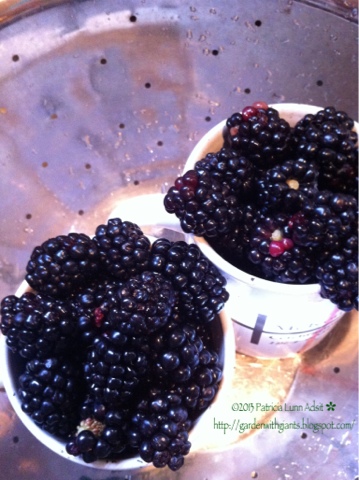
What is Summer? Earlier this year, the Grow Write Guild asked "what plant encapsulates the essence of summer" for you? That's easy! For me, nothing shouts "it's Summertime!" like the blackberry!


I see Summer, oozing from every ripe berry, which makes the colorful transition from the rich red of my ruby birthstone to the shiny ebony-black that announces the time for enjoying has arrived. I taste sweetness and warmth in every bite I pop in my mouth...straight from the bush or retrieved from my cup while still standing in the berry patch...who can bear to postpose gratification until the kitchen sink? I hear the long-ago peels of childhood laughter at finding the first arching canes, draped along the fence row on the farm, loaded with prizes for the picking. I feel the pricks and the scratches as the thorns try to keep me from the best rewards, deep within the bush...no matter; tis but a fleeting sensation, never deterring me for more than a moment.

When Mother Nature puts the "Ripe Now!" sign on the blackberries, I know that it is truly Summer!

Some things have changed with the years and across the miles. I no longer need to drive to the family farm for the annual outing to gather my favorite fruit; I have my own Berry Patch in our Way Back Garden. While I miss the comfort of connecting with cousins over common ground, I am thoroughly enjoying the convenience of having my very own U Pick 'Em.

Nor do I always need battle thorns, as we have planted two thornless varieties: Arapaho and Navajo. From North Carolina Cooperative Extension's online publication, Growing Blackberries in North Carolina:
The (Arapaho and Navajo) cultivars are from the University of Arkansas breeding program. These cultivars, named in honor of Native American tribes, do well in North Carolina...
Arapaho... Released by the University of Arkansas in 1993. Very erect, thornless, and suckers freely. Ripens 2 weeks earlier than Navaho, but has a short picking period. Fruit: good quality, medium size, short, conic, glossy black, firm, stores and ships better than most other blackberries; modest seed size. Up to this time has been resistant to double blossom in North Carolina, and orange rust has also seldom been observed. 
Navaho... Released by the University of Arkansas in 1988. Erect, thornless. Medium size berries of good quality; moderate to high productivity. Stores well, suitable for air transport. Susceptible to orange rust. Has not had a problem with double blossom in North Carolina up to this time.
Still, we continue to have the occasion to yell "ouch," as we also have several outcroppings of wild...and very thorny...bushes. We keep the wild ones so the birds will have their own...and hopefully leave "ours" for us, but can't resist taste-testing the tiny berries.

Growing blackberries is so easy...truly! Select a spot that gets full sun (8 hours daily), and where the soil tests to 6.0-6.5 pH. (We've added lime to the Berry Patch quadrant of the Way Back Garden per our 2011 Soil test recommendations to correct the high-acid 5.3 pH soil...great for blueberries; not "sweet" enough for blackberries and grapes.) In the late winter, I prune off any dead branches and spray with dormant oil, just like I do the Orchard and the Rose Garden...twice over a two-month period if the conditions are right...before any bud breaks. Then in the early spring, I feed each bush with 1/2 cup 10-10-10 and add mushroom compost in a collar around the base, just as the bushes begin to flower.


Since both of our varieties (Arapaho and Navajo) are erect or 'upright' blackberry cultivars, we have them planted 6 feet apart (for good air circulation) and supported by a two-wire trellis system; I use clothespins to help train the growing branches to the wires...when they put on fruit, those branches will get heavy. And that's it...just bide your time from early May (when the bushes flower) to early July (when the first fruits begin to ripen...and then enjoy the fruits of your labors!

The State of North Carolina publishes an excellent guide for growing Blackberries in the Home Garden; click here to go there.

And oh the wonderful things you can do with blackberries! How about a juicy cobbler? Yum! What about blackberry preserves? Most people make jelly or jam; me? I'm a fan of the seeds, if you can believe that, so I don't feel the need to strain them out of the finished product. But my grandfather did love a Jam Cake, made with blackberry jam...no seeds, please!

I had also hoped to have some blackberries to freeze, to enjoy my favorite fruit come next January. Alas, the season ended much too soon. Only managed a couple of quarts for the freezer. Sigh. Still this is only the second year for fruiting of these bushes, so I dream of heavier yields in the years to come.

Two last chores after the harvest and before we say goodbye to the blackberries for another year: 
(1) fertilizing with another 1/2 cup of 10-10-10, to encourage good growth of next year's fruiting canes; and (2) removing the 'spent' canes. You see, blackberries are produced on one-year-old canes, so the canes that produced so many lovely, juicy blackberries for us this year are done...spent...and must be lopped-off at ground level. Additionally, all those new canes need to be topped-off about a foot from the end of the new growth, to encourage the new canes to branch out with more new growth before frost.


All of these cuttings go into the yard waste toter and down to the street, off our property...not into the compost: too much opportunity for overwintering of insects and/or disease(s), so why take the chance?

Yes, the blackberry season is short and sweet, and I'm already anticipating breaking out one of those quarts of berries I have socked away in the freezer. But, no...must resist temptation for delayed gratification. 

A taste of Summer in the dead of Winter. The essence of a good life.